
You must look at your industry and the environment before choosing RFID cards and tags. Each industry has unique needs. For example, hotels need RFID cards that work with property management systems and electronic locks. You may also need to follow strict security rules or use special materials for your cards.
The environment also plays a big role. Different places can affect how RFID cards and tags work. The table below shows how common environmental factors can change RFID performance:
| Environmental Factor | Impact on RFID Performance |
|---|---|
| Metal Interference | Signal can get weak or lost. You may need special tags or shielding. |
| Liquid Absorption | Water can block signals. You need tags made for wet places. |
| Extreme Temperatures | Very hot or cold weather can break the card. Use temperature-stable RFID devices. |
| Electromagnetic Interference | Other signals can block RFID. Shielding and special designs can help. |
| High Humidity | Moisture can damage the card. Use moisture-resistant tags. |
You should set clear goals for your access control system. Think about how many people will use it and how your needs might grow. When you add more RFID tags and readers, you may need stronger servers and faster networks. Large places like hotels or stores can create a lot of data. Old systems may not handle this well.
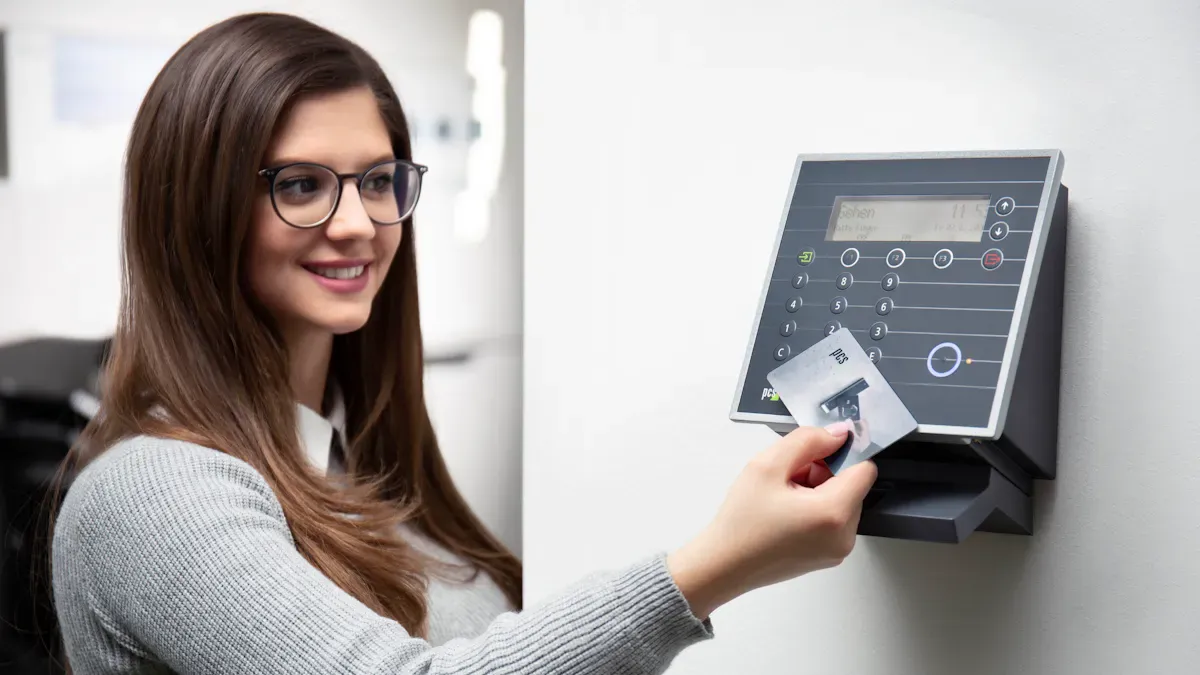
You need to understand how different frequencies affect RFID technology in access control and management. Each frequency has its own strengths and best uses. LF (Low Frequency) works at 125 kHz. It has a short read range, usually up to 10 centimeters, and slower data speeds. LF works well in places with metal or water, like industrial sites or areas with pipes. HF (High Frequency) operates at 13.56 MHz. It gives you a moderate read range, up to 30 centimeters, and faster speeds. HF is a good choice for high-security areas, smart cards, and hotel room access. UHF (Ultra-High Frequency) runs from 860 to 960 MHz. It offers the longest read range, from 1 to 12 meters, and the fastest data rates. UHF is best for parking gates, vehicle tracking, and large warehouses.
| Feature | LF (125 kHz) | HF (13.56 MHz) | UHF (860–928 MHz) |
|---|---|---|---|
| Read Range | Up to 10 cm (4") | Up to 30 cm (12") | 1 m – 12 m (3–40 ft) |
| Data Speed | Slow | Moderate | Fastest |
| Metal/Liquid Resistance | Excellent | Moderate | Poor (needs special tags) |
| Multi-Tag Reading | No | Limited | Yes |
| Typical Cost | Moderate–High | Moderate | Lowest |
| Common Applications | Access cards, key fobs | Smart cards, NFC payments | Parking gates, warehouses |
You should choose the frequency that matches your environment and needs. For example, use LF for building access where metal is present. Use HF for hotel rooms or payment cards. Use UHF for parking lots or tracking many items at once.
When you select chips for RFID technology in access control and management, you should know the main types. Passive RFID chips are common because they cost less and fit in small cards or tags. HF tags work well for hands-free access, like hotel doors. UHF tags are best for parking garages or places where you need a long read range.
Security is a key part of RFID technology in access control and management. You must protect your system from threats like card cloning or data theft. Look for chips with strong security features. Data encryption keeps information safe as it moves between the card and the reader. Anti-counterfeiting tools, such as dynamic keys and digital signatures, stop people from making fake cards. Multi-factor authentication makes sure only approved readers can access card data.
| Security Feature | Description |
|---|---|
| Data Encryption | Protects data sent between the RFID card and reader from being stolen or changed. |
| Anti-Counterfeiting | Uses special keys and signatures to stop fake cards. |
| Multi-Factor Authentication | Makes sure only trusted readers can read the card, using extra checks. |
You should also check the technical specs of your PVC RFID cards and tags. Look at the read range, memory size, and antenna design. Make sure the cards follow the right protocols, like ISO standards. This helps your RFID technology in access control and management work with other systems, such as property management or electronic locks.
By focusing on security and technical details, you make your RFID technology in access control and management safer and more reliable. You also make sure your system can grow and change as your needs do.
How do I know which RFID frequency to choose?
No. 225 , 2F , Hombo innovation Technology Industrial park ,Qingning Rd .Longhua district ,
Email : info@zjiotech.com


 English